
The Story Behind Kathy on the Couch and the Gap That Started Everything
Feb 18, 2026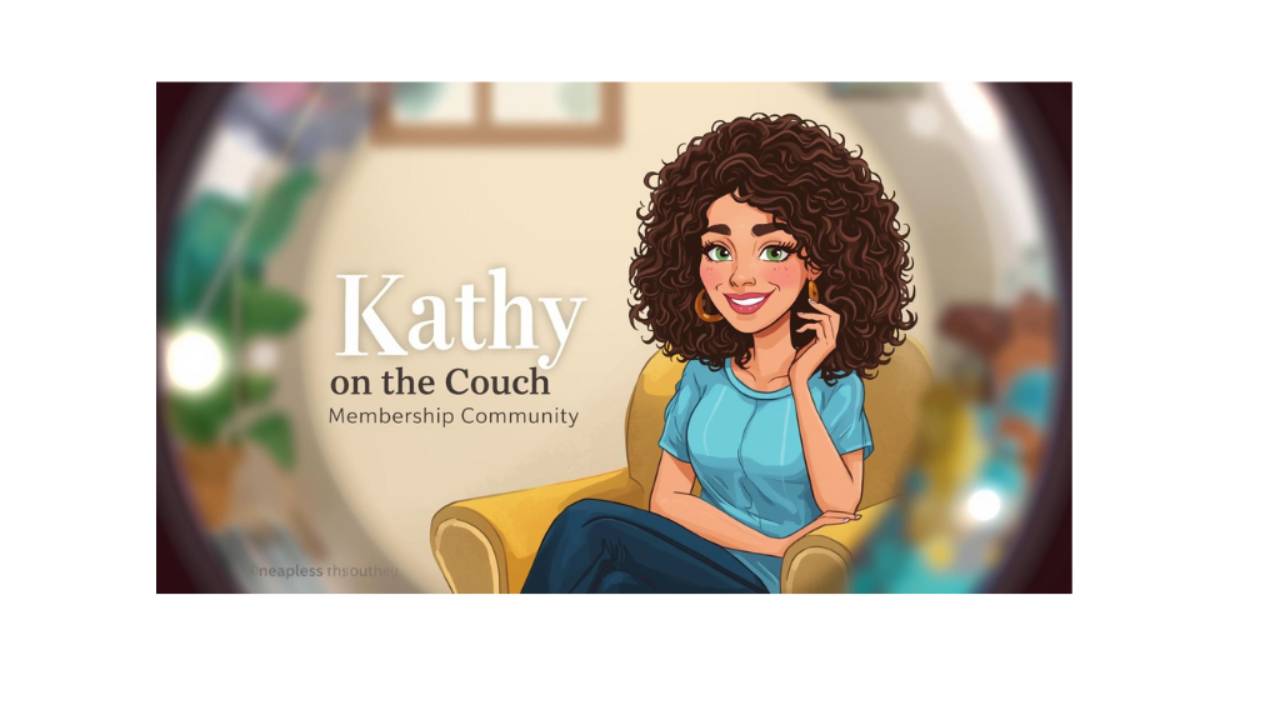
The Story Behind Kathy on the Couch and the Gap That Started Everything
By Kathy Couch, LCSW, FT
Fellow Thanatologist | EMDR Consultant | Clinical Traumatologist
Published: February 2026
I need to tell you the honest story of how Kathy on the Couch came to be. Not the polished version. The real one.
Because Kathy on the Couch didn’t start with a business plan or a marketing strategy or a vision board with perfectly curated fonts. It started with frustration. The kind of frustration that sits in your chest for years before you finally do something about it—the kind that whispers, “There has to be a better way to do this.”
And one day, I stopped whispering and started building.
The Gap Nobody Was Talking About
Here’s what I kept running into—and if you do this work, I’m betting you’ve run into it too.
I live in the space between trauma therapy and grief therapy. That intersection. The place where a client walks in carrying traumatic loss, or unresolved grief layered on top of a complex trauma history, or the kind of death that shatters every assumption about how the world is supposed to work. That place where trauma and grief aren’t two separate presenting problems—they’re woven together so tightly you can’t address one without addressing the other.
And I kept looking around for my people. The clinicians who understood both sides. The ones who weren’t just trauma therapists who occasionally saw a grieving client, or grief counselors who occasionally encountered a trauma response. I was looking for the ones who lived in the overlap—who knew that grief can be traumatic and trauma always involves loss, and that treating one without understanding the other is like trying to read a book with half the pages missing.
And I couldn’t find them. Not in one place, anyway.
The Patchwork Problem
What I found instead was a patchwork. And honestly? I lived in that patchwork for years.
I’d go to a trauma training—a really good one—and walk away with solid clinical skills and maybe some decent handouts. But grief was barely mentioned, and when it was, it felt like an afterthought. Like grief was just another “target” rather than an entire clinical domain with its own theory base, its own assessment frameworks, its own complications.
Then I’d go to a grief training—a beautiful one—and learn about continuing bonds and meaning-making and the dual-process model. But the moment a client presented with a traumatic death or a complex trauma history underneath the grief, the training didn’t have the tools. It wasn’t designed to go there.
Then I’d go to an EMDR conference and learn incredible processing techniques, but the grief-specific applications were a niche workshop you had to hunt for, and the community conversation was about PTSD protocols and bilateral stimulation research—not about the clinician sitting with a mother who watched her child die and doesn’t know how to keep breathing.
And somewhere in between all of that—between the trauma training and the grief training and the EMDR conference and the continuing education catalog and the journal articles and the clinical books stacked on my nightstand—I was also trying to manage my own nervous system. My own secondary trauma. My own grief about the work. And there was no place for that either.
I had material coming from a dozen different directions. What I didn’t have was a home.
What Was Really Missing
Let me name the specific things I couldn’t find in one place, because I think this list will feel familiar to you:
- A community of like-minded clinicians who understood the trauma-grief intersection and could talk about it with nuance—not surface-level “self-care tip” conversations, but real, clinical, sometimes messy conversations about the cases that keep you up at night.
- Consultation that actually fit. Not generic peer supervision with clinicians who don’t specialize in this work. Consultation with people who know what it’s like to sit with traumatic loss, who understand dissociation, who can help you think through a grief case that’s not following any textbook trajectory.
- Quality handouts and clinical resources that I didn’t have to create from scratch every time I needed to explain something to a client. Psychoeducation materials, resourcing scripts, assessment guides, documentation templates—the stuff that supports the clinical work but takes hours to develop on your own.
- Continuing education that went deep. Not the kind of CE where you sit through six hours of content you already know to check a licensing box. The kind where you actually learn something that changes how you practice on Monday morning. Training that bridges trauma and grief instead of treating them as separate silos.
- Honest conversation about self-care and sustainability. Not the bubble bath version. The real version—where clinicians can say, “This case is wrecking me and I don’t know how to hold it,” and someone who does this same work can say, “I know. Let’s talk about it.”
- Support that didn’t require stitching together five different memberships, three Facebook groups, two listservs, and a prayer. Everything in one spot. For people like us.
That’s a lot of things to be missing. And I kept thinking somebody else would build it. Somebody with more experience, more credentials, more whatever it is you think you need before you’re allowed to create something. I kept waiting for the place to exist so I could join it.
It didn’t exist. So I built it.
How Kathy on the Couch Was Born
The name came from who I actually am in this work. I’m not the clinician standing at the podium in a blazer pretending to have it all figured out. I’m the one on the couch—processing alongside you, figuring it out in real time, willing to say “I don’t know, but let’s figure it out together.” That felt true. That felt like the energy this community needed.
The vision was simple: build the place I wished had existed when I was searching. One home where trauma and grief clinicians could find everything they need—consultation, education, clinical resources, and each other—without having to piece it together from ten different sources.
Not a training company that sells you a weekend and disappears. Not a Facebook group where you post a clinical question and get seventeen different opinions from people who may or may not actually do this work. Not a membership site with a pretty interface and content that never gets updated.
A community. A real one. Where the people inside it are as important as the content.
What Kathy on the Couch Actually Is
Let me tell you what’s in the room, because I built every piece of this based on what I needed and couldn’t find.
Consultation
Real, case-based consultation with clinicians who specialize in trauma and grief. Not generic supervision. Not someone reading a treatment manual back at you. The kind of consultation where you bring the case that’s got you stuck—the client with the complicated grief and the dissociative features and the family system that’s making everything harder—and you get thoughtful, experienced, clinical support from people who have sat in that same chair.
This is the piece that changes practice. I know because it’s the piece that changed mine. Every clinician doing difficult work needs someone who can say, “Yes, that’s the right instinct. Here’s why it’s hard. Here’s what to try next.”
Continuing Education That Actually Continues Your Education
CEs that are designed for clinicians living in the trauma-grief intersection. Not general mental health training with a grief lecture tacked on. Training that goes deep on the things that matter in this work: EMDR with grief and loss targets, traumatic dissociation, the three channels of processing, evidence-based documentation, resourcing frameworks, cultural considerations in grief and mourning, advance care planning, meaning-making after traumatic death—the real clinical content that makes you a better therapist for the people sitting across from you.
And the handouts are actually good. I know that sounds like a small thing, but if you’ve ever walked out of a training with a 47-page slide deck printed six-to-a-page in grayscale and thought, “I will literally never look at this again,” you know it’s not a small thing. The clinical resources in this community are designed to be used—in session, in documentation, in your clinical thinking.
A Place to Talk About the Hard Things
This is the heart of it. This is what I built all of this around.
The hard things. The cases that follow you home. The client’s grief that activates your own. The secondary traumatic stress that builds so slowly you don’t notice it until you’re sitting in your car after the last session of the day and you can’t make yourself drive home. The compassion fatigue. The moments of doubt—am I even helping? Is this doing anything? Am I good enough at this to hold what this person is handing me?
We don’t talk about those things enough. We definitely don’t talk about them in spaces that feel safe enough to be honest. And here’s what I know from doing this work for as long as I have: the clinicians who burn out aren’t the ones who care too much. They’re the ones who didn’t have anywhere to put it. They’re the ones who held everything alone.
Kathy on the Couch is a place where you don’t have to hold it alone.
Everything in One Spot
Consultation. CEs. Handouts. Clinical resources. Community. Self-care that’s actually about sustainability, not performative wellness. Support from people who do the same work you do and understand what it costs.
One membership. One place. No more stitching together five platforms and hoping the pieces fit.
Who This Is For
Kathy on the Couch is for the clinician who does the hard work.
It’s for the therapist who works with traumatic loss and doesn’t have a colleague in their office who understands what that means. It’s for the EMDR clinician who knows they need to go deeper on grief and dissociation and can’t find a training that bridges the gap. It’s for the grief counselor who keeps encountering trauma in their clients and wants the clinical tools to work with it safely. It’s for the solo practitioner who is doing this work in isolation and feeling the weight of it. It’s for the experienced clinician who wants a community of peers, not another basic training. And it’s for the newer clinician who knows they’re in deep water and wants a guide.
If you’ve ever thought, “I wish I had a group of people who really get this work,”—this is what I built for you.
The Reason Under the Reason
I’m going to be honest about one more thing, because I think it matters.
I didn’t just build Kathy on the Couch because there was a gap in the market. I built it because there was a gap in me. I needed this community too. I needed a place where I could show up as the clinician who has questions, not just the one who has answers. A place where I could process the weight of this work with people who understand it. A place where growth and vulnerability and clinical excellence could coexist without anyone pretending they have it all figured out.
That’s the energy of this community. We are clinicians who are still learning. Still growing. Still sitting with the hard stuff and choosing to keep going—not because it’s easy, but because the people we serve deserve clinicians who are supported, resourced, and connected to something bigger than their solo practice.
The Summit Method came from a meditation. Kathy on the Couch came from the gap. Both came from the same truth: the work we do matters too much to do it alone, and the people doing it deserve better than a patchwork.
Your Couch Is Waiting
If any of this landed—if you read something in here and felt that little exhale of “finally, someone said it”—I want you to know: this community was built with you in mind. Every piece of it. The consultation, the CEs, the resources, the conversations. All of it.
You don’t have to do this work alone anymore. You don’t have to stitch together five different sources to get what you need. You don’t have to pretend you’re fine when the work is heavy.
Come sit on the couch. We saved you a spot.
Welcome to Kathy on the Couch.
With you on the trail,
Kathy
Kathy Couch, LCSW, FT Willow Creek Health · Rewired360 · Kathy on the Couch
© 2026 Kathy Couch, LCSW, FT. All Rights Reserved.
The Summit Method™ and Kathy on the Couch™ are the intellectual property of Kathy Couch / Willow Creek Health / Rewired360.
No part of this publication may be reproduced, distributed, or transmitted in any form or by any means,
including photocopying, recording, or other electronic or mechanical methods, without the prior written
permission of the author, except in the case of brief quotations embodied in critical reviews and certain
other noncommercial uses permitted by copyright law.
For permission requests, contact: Kathy Couch at Willow Creek Health / Rewired360.
Stay Connected
Get resources, motivation, and guided activities delivered to your inbox.
Don't worry, your information will not be shared.
