|
REWIRED360
Rooted Practice
|
Pedagogical Roots Series
|
|
|
Post 2 of 6
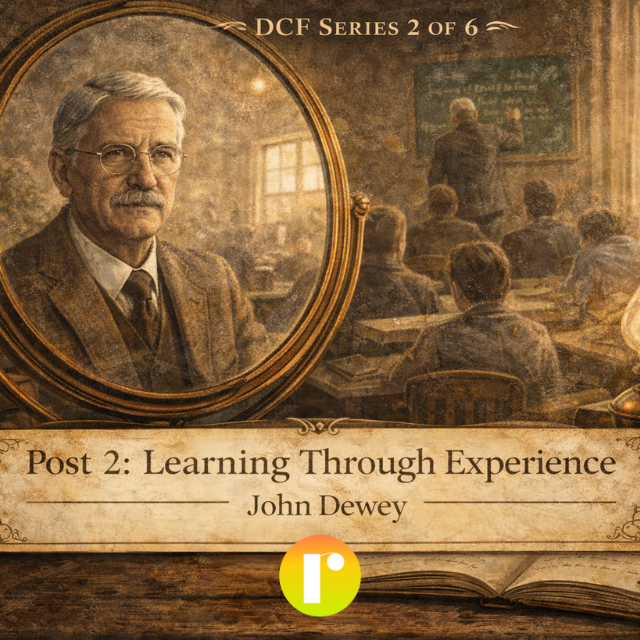
John Dewey: Experience, Democracy, and the Regulated Learner
For Dewey, experience was not the warm-up before learning began. Experience was the medium of learning itself.
Pedagogical Roots Series · Kathy Couch, LCSW, FT · Rewired360
|
|
John Dewey wrote his landmark work Experience and Education in 1938, when he was nearly eighty years old. It was, in many ways, a corrective — a response to critics who had taken his earlier ideas about progressive education and applied them carelessly, producing chaotic classrooms with no structure, no rigor, and no meaningful learning.
Dewey was not interested in the absence of structure. He was interested in a different kind of structure — one organized around the learner’s experience rather than the teacher’s delivery. The distinction matters enormously. And it has direct implications for how we design professional training spaces in trauma-informed clinical communities.
|
Experience as the Ground of Learning
Dewey’s central argument in Experience and Education is deceptively simple: learning that does not connect to a learner’s lived experience does not last, and may not even truly occur (Dewey, 1938). Information delivered in abstraction — disconnected from the sensory, emotional, and relational context of a learner’s actual life — fails to engage the neural systems that make memory encoding and integration possible.
He distinguished between what he called educative and miseducative experiences. An educative experience is one that expands the learner’s capacity for future experience — it opens rather than closes, connects rather than fragments, builds agency rather than dependency. A miseducative experience does the opposite. It may involve the transmission of accurate information, but it leaves the learner less able, not more able, to engage with complexity going forward (Dewey, 1938).
In professional training contexts, the question Dewey invites us to ask is not: Was the content correct? It is: Was the experience educative? Did it expand participants’ capacity? Did it build on what they already knew? Did it leave them more curious, more competent, more confident — or more overwhelmed, more passive, more dependent on the trainer’s authority?
|
“Accurate content delivered in miseducative conditions produces compliance, not learning. And in trauma-informed fields, compliance is a clinical warning sign, not a training goal.”
|
|
What Neuroscience Adds: Embodied Cognition and State-Dependent Learning
Dewey wrote without access to neuroimaging or polyvagal theory. But his insistence that learning is grounded in the body’s engagement with its environment anticipates what researchers now describe as embodied cognition — the finding that thought, memory, and learning are not purely abstract processes occurring in an isolated brain, but are fundamentally shaped by the body’s sensorimotor experience in context (Shapiro, 2011; Wilson, 2002).
Neuroscience has since confirmed that memory encoding is state-dependent: information is most effectively consolidated when learners are in a regulated, engaged physiological state, and when new information is connected to existing neural networks built from prior experience (Tyng et al., 2017; Immordino-Yang & Damasio, 2007). Abstract information delivered to a disengaged or dysregulated nervous system produces shallow encoding — the learner may be able to repeat the information immediately after the training, but integration into clinical practice is unlikely.
This is not a peripheral concern for continuing education providers. It is the central problem. The gap between knowing and doing — between training attendance and behavior change in clinical practice — is one of the most persistent challenges in continuing education research (Davis et al., 1999). Dewey’s framework suggests that this gap is not primarily a motivation problem. It is an experience design problem.
|
“If we want learning that transfers to clinical practice, we must design experiences that connect to clinical practice. Abstract delivery produces abstract knowing.”
|
|
Democracy and the Learning Community
Dewey’s educational philosophy cannot be separated from his political philosophy. For Dewey, education and democracy were inseparable — not because schools should teach civic content, but because the experience of learning in community is itself a democratic practice or its opposite (Dewey, 1916).
A genuinely democratic learning community is one in which every member’s experience is treated as evidence, every voice has access to the conversation, and the collective intelligence of the group is understood to exceed the knowledge of any single expert. This is not idealism. It is a description of how knowledge actually develops in healthy scientific and clinical communities.
Dewey was deeply suspicious of what he called the spectator theory of knowledge — the idea that learning is the passive observation of transmitted truth. He argued that knowing is always an active, participatory, relational process. The learner constructs meaning; they do not receive it (Dewey, 1929). For clinical training spaces, this means that training designs that position participants primarily as spectators — watching presentations, absorbing content, performing agreement — are not merely less engaging. They are working against the fundamental conditions under which integration occurs.
|
Reflection, Continuity, and the Arc of Learning
Two concepts from Dewey’s work are particularly useful for continuing education designers: continuity and reflection.
|
Continuity
Dewey argued that educative experiences must be continuous — they must connect to what came before and reach forward toward what comes next. A training that treats itself as a standalone event, disconnected from participants’ prior learning and unconnected to their future practice, violates the principle of continuity and is unlikely to produce lasting change (Dewey, 1938). This is why series-based educational design, post-training follow-up, and the integration of reflective practice structures are not merely nice-to-have enhancements. They are the mechanisms through which continuity is honored — and through which neural consolidation of new learning is supported (Kolb, 1984).
|
|
Reflection
Dewey also emphasized that experience alone is not sufficient for learning. Reflection on experience is what transforms raw encounter into understanding. Without structured reflection, participants may have powerful experiences during a training without being able to articulate, integrate, or transfer what they learned (Dewey, 1933). In practice, this means building explicit reflection structures into training design — not as add-ons at the end of the day, but as integral to the learning arc throughout. Small group discussion, written reflection, case application, peer consultation: these are not departures from content delivery. They are the conditions under which content becomes learning.
|
|
Dewey in Trauma-Informed Clinical Training
The through-line from Dewey to trauma-informed practice is shorter than it might appear. The polyvagal framework’s emphasis on physiological state as the foundation for engagement, the somatic therapy field’s insistence that the body must be included in the healing process, the relational neuroscience literature’s documentation of co-regulation as the medium of change — all of these converge on Dewey’s core insight that learning is an embodied, relational, experiential process (Porges, 2011; van der Kolk, 2014; Siegel, 2010).
When we design training spaces that ignore participants’ physiological states, that treat their prior clinical experience as irrelevant, and that offer no structure for reflection or continuity — we are designing miseducative experiences, in Dewey’s terms. And we should not be surprised when the gap between training attendance and clinical behavior change remains stubbornly wide. Dewey’s invitation is to take seriously the claim we already make in clinical work: that how we are with people matters as much as what we know.
|
Clinical Application: Design Questions from Dewey
These questions are not rhetorical. They are practical design tools.
|
How does this training connect to the specific clinical experience participants bring into the room?
|
|
What structures for reflection are built into the training arc — not appended at the end, but woven throughout?
|
|
How does this training connect forward to participants’ future practice? What continuity structures support integration after the training ends?
|
|
In what ways does the training design position participants as active constructors of meaning versus passive spectators of content?
|
|
Are participants’ physiological states being attended to — through pacing, movement, regulation breaks, and explicit permission to self-regulate?
|
|
References
Davis, D., Thomson, M. A., Oxman, A. D., & Haynes, R. B. (1999). Changing physician performance: A systematic review. JAMA, 274(9), 700–705.
Dewey, J. (1916). Democracy and education. Macmillan.
Dewey, J. (1929). The quest for certainty. Minton, Balch & Company.
Dewey, J. (1933). How we think. D. C. Heath.
Dewey, J. (1938). Experience and education. Macmillan.
Immordino-Yang, M. H., & Damasio, A. (2007). We feel, therefore we learn. Mind, Brain, and Education, 1(1), 3–10.
Kolb, D. A. (1984). Experiential learning. Prentice-Hall.
Porges, S. W. (2011). The polyvagal theory. W. W. Norton & Company.
Shapiro, L. (2011). Embodied cognition. Routledge.
Siegel, D. J. (2010). The mindful therapist. W. W. Norton & Company.
Tyng, C. M., Amin, H. U., Saad, M. N. M., & Malik, A. S. (2017). The influences of emotion on learning and memory. Frontiers in Psychology, 8, Article 1454.
van der Kolk, B. A. (2014). The body keeps the score. Viking.
Wilson, M. (2002). Six views of embodied cognition. Psychonomic Bulletin & Review, 9(4), 625–636.
|
|
Pedagogical Roots Series
← Post 1: Paulo Freire — The Banking Model and the Trauma of Being Taught At
→ Next: Post 3: Lev Vygotsky — The Zone of Proximal Development as a Window into Nervous System Co-Regulation
|
|
|
|
REWIRED360
Rewiring how therapists learn, lead & thrive.
|
© 2026 Kathy Couch, LCSW. All rights reserved.
Intended for professional continuing education purposes.
|
|
|


