|
REWIRED360
Kathy on the Couch
|
Member Library
|
|
|
Pedagogical Roots Series · Post 4 of 6
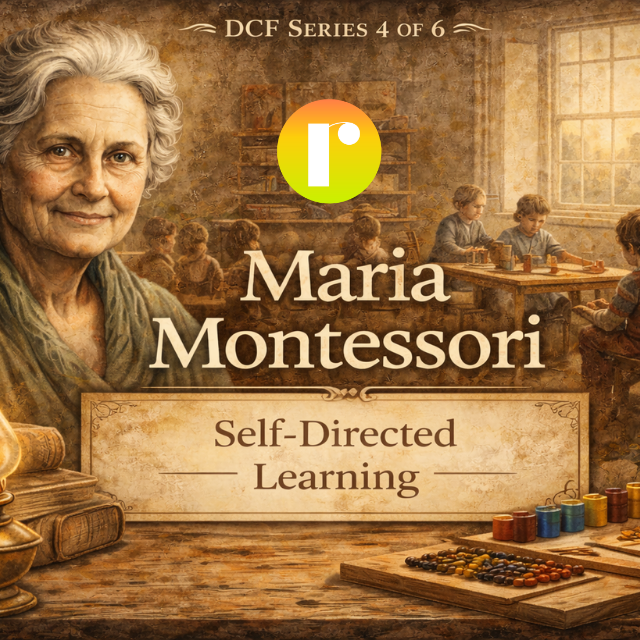
Maria Montessori
Self-Directed Learning and Autonomic Safety
|
|
Maria Montessori was trained as a physician, not an educator. Her entry into educational work came through her clinical observations of children whom the medical establishment had written off as uneducable — children with developmental differences who, when given structured independence and carefully designed materials, demonstrated capacities that their institutional environments had systematically suppressed.
This origin story is worth holding. Montessori did not develop her educational philosophy from abstract theory. She developed it from clinical observation of what happened when learners were given genuine agency in a carefully prepared environment. What she observed — that children allowed to direct their own learning demonstrated remarkable focus, intrinsic motivation, and joyful engagement — was both a pedagogical finding and, in retrospect, a neuroscientific one.
|
|
"Montessori watched the ventral vagal system come online in children who had been living in dorsal shutdown. She did not have that language. But that is what she saw."
|
|
The Prepared Environment: Conditions for Natural Learning
Montessori's concept of the "prepared environment" is perhaps the most underappreciated element of her framework for adult professional education contexts. She argued that the educator's primary responsibility is not to deliver content but to design and maintain an environment in which natural learning can unfold (Montessori, 1912). The teacher steps back — not into absence, but into a different role: observer, guide, and curator of conditions.
The prepared environment is organized to invite exploration, respects the learner's sensory system rather than overwhelming it, offers genuine choice within a coherent structure, and communicates through every design decision that the learner is trusted to direct their own engagement. For adult professional learners, a training environment that offers no meaningful choice and that communicates through its structure that the trainer's agenda overrides the learner's need — is an unprepared environment in Montessori's terms.
|
What Neuroscience Adds: Polyvagal Theory and the Safety of Exploration
Stephen Porges' polyvagal theory offers a neurobiological account of precisely what Montessori observed clinically (Porges, 2011). Genuine learning — the kind that involves curiosity, exploration, integration, and the creative application of new knowledge — requires ventral vagal access. It cannot occur from sympathetic threat activation or dorsal shutdown. And ventral vagal access is directly supported by cues of safety in the environment: physical comfort, predictable structure, social warmth, and — critically — the experience of having agency over one's own engagement.
Research on intrinsic motivation confirms this neurobiologically. Ryan and Deci's self-determination theory identifies autonomy, competence, and relatedness as the three core conditions for intrinsic motivation — and demonstrates that environments that undermine autonomy produce not merely less enthusiasm but measurable decreases in learning quality, creativity, and long-term retention (Ryan & Deci, 2000).
|
|
"Agency is not merely a motivational preference. It is a physiological cue of safety. When learners can direct their own engagement, their nervous systems register: I am not prey here."
|
|
Freedom Within Structure: Not Chaos, Not Control
A persistent misreading of Montessori's framework is the equation of self-directed learning with the absence of structure. Montessori was emphatic that this was a distortion. Freedom in her framework is always freedom within a carefully prepared structure — not the absence of limits, but the presence of a coherent environment in which the learner's agency can operate meaningfully (Montessori, 1912).
Structure is not the problem. Control masquerading as structure is the problem. The goal is to ensure that structure serves learning rather than controlling it. The alternative is not structure versus freedom — it is the question of whose needs the structure serves: the trainer's anxiety about coverage and control, or the learner's need for safety, agency, and meaningful engagement.
|
Trauma History and Self-Direction: A Clinical Consideration
For participants with histories of complex trauma, the experience of genuine self-direction in a learning environment can be both powerful and disorienting. Many trauma survivors have organized their relationship to institutional environments around compliance — learning, often through painful experience, that safety requires submission to external authority rather than trust in one's own perception and agency.
Trauma-informed trainers who use Montessori-informed design need to hold this complexity: the invitation to self-direction is clinically valuable precisely because it offers something different from what many participants have experienced in institutional environments. But it requires explicit support, clear structure within the freedom, and an attuned trainer presence that makes the safety of the offer legible — not merely assumed.
|
Clinical Application: Montessori-Informed Training Design
|
Design the physical training environment with sensory awareness — lighting, seating arrangement, visual organization, and temperature all communicate safety or threat to the nervous system.
|
|
Build genuine choice into the training structure: choice of application case, choice of reflection partner, choice of engagement format where feasible.
|
|
Sequence content to honor participants' existing competence before introducing challenge — competence before complexity.
|
|
Step back from the impulse to fill every silence and direct every moment; create space for participants' natural curiosity and self-direction to operate.
|
|
When participants seem disengaged or compliant rather than genuinely engaged, consider whether the training environment is activating threat rather than safety.
|
|
References
Dana, D. (2018). The polyvagal theory in therapy. W. W. Norton.
Herman, J. L. (1992). Trauma and recovery. Basic Books.
Montessori, M. (1912). The Montessori method. Frederick A. Stokes Company.
Montessori, M. (1949). The absorbent mind. Theosophical Publishing House.
Porges, S. W. (2011). The polyvagal theory. W. W. Norton.
Ryan, R. M., & Deci, E. L. (2000). Self-determination theory. American Psychologist, 55(1), 68–78.
Walker, P. (2013). Complex PTSD: From surviving to thriving. Azure Coyote.
|
|
Series Navigation
↠Post 3: Lev Vygotsky — The Zone of Proximal Development as a Window into Nervous System Co-Regulation
→ Post 5: bell hooks — Engaged Pedagogy as Trauma-Informed Practice
|
|
|
|
REWIRED360
Rewiring how therapists learn, lead & thrive.
|
© 2026 Kathy Couch, LCSW. All rights reserved.
|
|
|