|
REWIRED360
Rooted Practice
|
Pedagogical Roots Series
|
|
|
Post 1 of 6
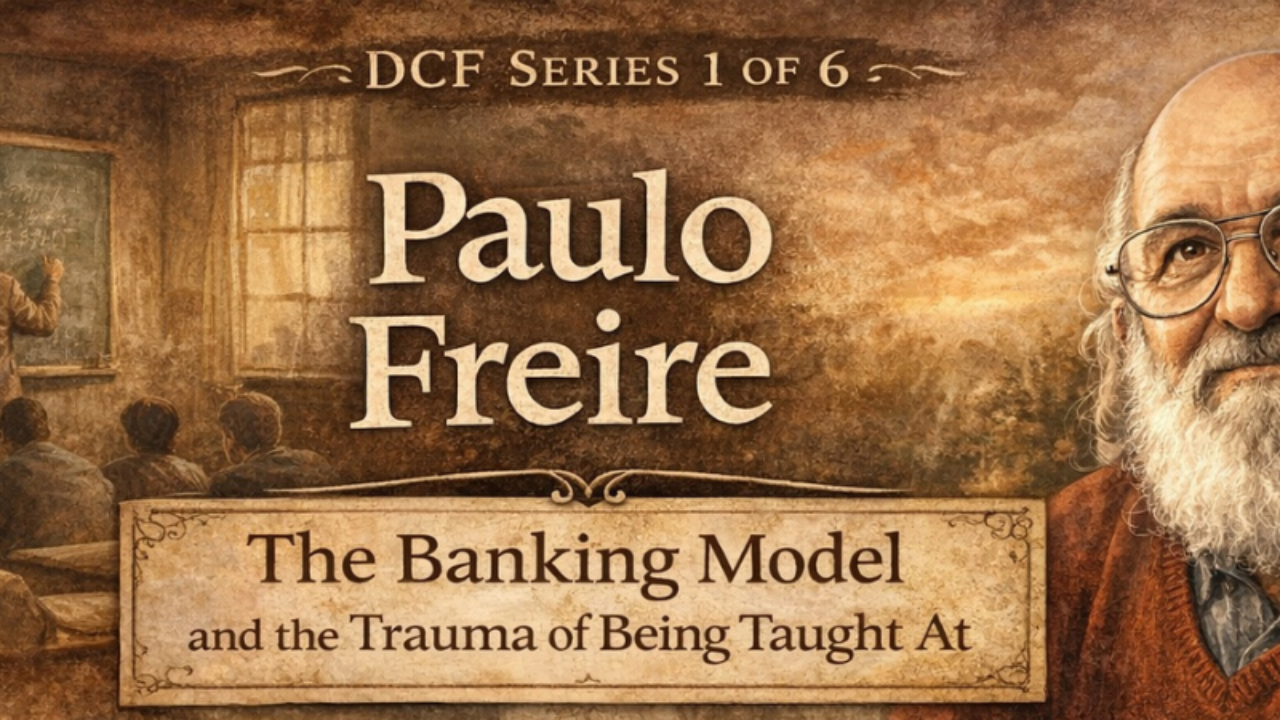
Paulo Freire: The Banking Model and the Trauma of Being Taught At
Freire named as a political problem what neuroscience has since confirmed as a biological one.
Pedagogical Roots Series · Kathy Couch, LCSW, FT · Rewired360
|
|
Paulo Freire never worked with trauma clinicians. He was a Brazilian educator and philosopher writing in the 1960s and 1970s, primarily about literacy education with impoverished and marginalized communities in South America. His masterwork, Pedagogy of the Oppressed, was written in exile after the Brazilian military government imprisoned and then deported him for the subversive act of teaching peasants to read.
And yet his central argument — that the dominant model of education is inherently dehumanizing, and that this dehumanization has physiological and psychological consequences — reads, decades later, like a clinical description of what happens in the nervous system when a learner is treated as a passive object rather than an active subject.
|
The Banking Model: Education as Domination
Freire’s most enduring contribution to educational theory is his critique of what he called the “banking model” of education (Freire, 1970). In this model, the teacher is the authoritative depositor of knowledge. The student is the empty account — a vessel to be filled. Teaching is the act of making deposits. Learning is the act of receiving them without alteration, distortion, or resistance.
Freire argued that this model is not pedagogically neutral. It is politically loaded. It trains learners to be passive, docile, and accepting of authority. It tells them, implicitly and explicitly, that their own experience, perception, and knowledge are without value until validated by someone with institutional power. It rewards compliance and penalizes critique.
|
“The banking model does not merely fail to educate. It actively teaches learners to distrust themselves.”
|
In clinical terms, this is recognizable. We call it learned helplessness. We call it externalized locus of control. We call it the internalized belief — so common in complex trauma — that one’s own perceptions cannot be trusted, that authority defines reality, and that safety requires submission (van der Kolk, 2014; Herman, 1992).
|
What Neuroscience Adds: Agency, Threat, and the Prefrontal Cortex
When Freire described the dehumanizing effects of the banking model, he was working from philosophical and political frameworks. Contemporary neuroscience offers a complementary biological account.
Research on the prefrontal cortex — the region most associated with executive function, learning, and integration — consistently demonstrates that perceived loss of agency activates threat circuitry (Arnsten, 2015). When a learner cannot influence the pace, direction, or relevance of their learning; when their questions are unwelcome; when their experience is treated as irrelevant to the content being delivered — the amygdala registers this as threat.
Under threat, norepinephrine and dopamine systems that support higher-order cognition are disrupted. Working memory narrows. Cognitive flexibility decreases. The learner becomes less able to integrate new information — not because they are resistant or disengaged, but because their nervous system has correctly identified that the environment is not safe for exploration (Arnsten, 2015; Lupien et al., 2009).
|
“The banking model is not merely philosophically problematic. It is neurologically counterproductive.”
|
Conversely, research on agentic learning — in which learners have meaningful choice and influence over their educational experience — shows enhanced dopaminergic reward signaling, improved memory consolidation, and greater capacity for creative and integrative thinking (Murty et al., 2012; Patall et al., 2008). Freire intuited what brain imaging now demonstrates: when people are treated as active agents in their own learning, they learn better. When they are treated as passive recipients, they learn less — and the cost is not only cognitive, but relational and psychological.
|
Problem-Posing Education: The Alternative
Freire did not stop at critique. He proposed an alternative he called problem-posing education — a model grounded in dialogue, mutual inquiry, and what he termed praxis: the integration of reflection and action (Freire, 1970). In problem-posing education, the teacher does not deposit information. The teacher poses problems drawn from the lived reality of learners, and learning emerges from the collaborative process of examining, questioning, and acting on those problems. The teacher is also a learner. The learner is also a teacher. Knowledge is not a fixed commodity to be transferred but a living process to be created together.
For clinical training spaces, this has direct and practical implications:
|
Beginning trainings by eliciting what participants already know — and treating that knowledge as foundational, not merely a warm-up exercise.
|
|
Designing content around questions that participants actually have, rather than content that trainers assume they need.
|
|
Creating space for dissent, alternative frameworks, and the kind of productive disagreement that advances both individual and collective understanding.
|
|
Modeling intellectual humility — the willingness of the trainer to be changed by the encounter.
|
|
“A trainer who cannot be questioned is not a teacher. They are a depositor. And depositors do not create conditions for learning — they create conditions for compliance.”
|
|
Freire in Trauma-Informed Professional Communities
The relevance of Freire’s framework to trauma-informed practice extends beyond pedagogy. His analysis of the banking model mirrors what trauma researchers have described as the dynamics of chronic disempowerment: the systematic erosion of the belief that one’s perceptions, needs, and responses are legitimate (Herman, 1992; Walker, 2013).
When professional training spaces replicate these dynamics — correcting participants publicly, penalizing dissent, rewarding performance of agreement — they are not simply failing pedagogically. They are, for participants with histories of relational trauma, reactivating familiar experiences of invalidation and powerlessness. This does not require intent. The banking model operates structurally. A trainer can be genuinely well-intentioned and still design a learning environment that communicates, at every turn, that the learner’s own experience is irrelevant to the content being delivered. Freire’s contribution is to help us see that this structural dynamic is neither neutral nor inevitable — it is a choice, and a different choice is possible.
|
A Personal Reflection: When Freire Validates What You Already Knew
In developing this series, something unexpected happened. Reading Freire carefully — not as an academic exercise but as a clinical and professional practitioner — felt less like encountering new theory and more like finding language for something already lived. The orientation toward servant leadership, the instinct to consult rather than pronounce, the impulse to ask what others know before offering what I know, the discomfort with positional authority that forecloses dialogue: these were already present, already practiced, already taught to others. Freire did not create them. He named them.
This is worth naming not as self-disclosure for its own sake, but because it illustrates something Freire would recognize: that the principles of problem-posing education, of genuine dialogue, of consultation as a primary leadership orientation, are not abstract ideals requiring conscious installation. For many clinical practitioners, they emerged organically — from the therapeutic relationship, from the experience of being genuinely changed by clients and supervisees, from the discovery that the most effective leadership is the kind that increases others’ capacity rather than one’s own centrality.
|
“Freire validated what servant leadership practice had already demonstrated: when you genuinely consult, genuinely listen, and genuinely share authority, people do not become dependent. They become capable. That is the point.”
|
|
On Being Changed: A Scene from Only the Brave
When bell hooks writes that engaged pedagogy requires the teacher to be willing to be changed by the encounter, it can sound like a philosophical aspiration. Abstract. Professional. Safe at the level of principle while remaining unrealized in practice. It helps to have a concrete image of what that transformation actually looks like when it arrives — and what it costs, and what it means.
The 2017 film Only the Brave tells the true story of the Granite Mountain Hotshots, an elite wildland firefighting crew who lost nineteen of twenty members in the Yarnell Hill Fire of 2013. In one of the film’s most powerful scenes, Amanda Marsh confronts her husband Eric about the fact that she has changed her mind about wanting children. What she says stops the scene: that he changed her. Not as accusation. As fact. As testimony to what genuine relationship had done to her over time — because that is what real relationship does. She did not decide to be changed. She was changed. By proximity. By love. By the slow accumulation of shared life with someone whose humanity had worked on her in ways she could not have predicted and cannot undo.
|
“Relationships are supposed to do that. And we are missing something very important if we forget it.”
|
A training space that is designed to prevent the trainer from being changed — that fortifies authority, forecloses challenge, and rewards participants only for receiving content — is a space that has opted out of relationship. It has chosen transaction over transformation. And the cost of that choice is borne not only by participants, but by the trainer who will leave the room the same person they entered it. Every time.
|
Clinical Application: Questions for Educators and Trainers
These are not abstract questions. They are design questions. And the answers to them shape whether learning happens — and whether it happens safely.
|
In what ways does my training design position participants as passive recipients rather than active contributors?
|
|
How do I respond when a participant challenges the content I am presenting? Does that response invite dialogue or foreclose it?
|
|
Whose knowledge counts in my training room? Whose experience is treated as evidence?
|
|
Am I willing to be changed by this encounter — to let participant questions and challenges genuinely alter my understanding?
|
|
What structural features of my training space — physical layout, pacing, participation structures — reinforce or challenge the banking model?
|
|
References
Arnsten, A. F. T. (2015). Stress weakens prefrontal networks: Molecular insults to higher cognition. Nature Neuroscience, 18(10), 1376–1385.
Freire, P. (1970). Pedagogy of the oppressed (M. B. Ramos, Trans.). Herder and Herder.
Herman, J. L. (1992). Trauma and recovery. Basic Books.
Lupien, S. J., McEwen, B. S., Gunnar, M. R., & Heim, C. (2009). Effects of stress throughout the lifespan on the brain, behaviour and cognition. Nature Reviews Neuroscience, 10(6), 434–445.
Murty, V. P., Ritchey, M., Adcock, R. A., & LaBar, K. S. (2012). fMRI studies of successful emotional memory encoding. Neuropsychologia, 50(13), 2545–2554.
Patall, E. A., Cooper, H., & Robinson, J. C. (2008). The effects of choice on intrinsic motivation. Psychological Bulletin, 134(2), 270–300.
van der Kolk, B. A. (2014). The body keeps the score. Viking.
Walker, P. (2013). Complex PTSD: From surviving to thriving. Azure Coyote.
|
|
Pedagogical Roots Series
← Post 0: Roots of the Revolution — Series Introduction
→ Next: Post 2: Vygotsky The ZPD in Consultation — Letting the Consultee Lead
|
|
|
|
REWIRED360
Rewiring how therapists learn, lead & thrive.
|
© 2026 Kathy Couch, LCSW. All rights reserved.
Intended for professional continuing education purposes.
|
|
|