|
REWIRED360
Kathy on the Couch
|
Member Library
|
|
|
Pedagogical Roots Series · Post 3 of 6
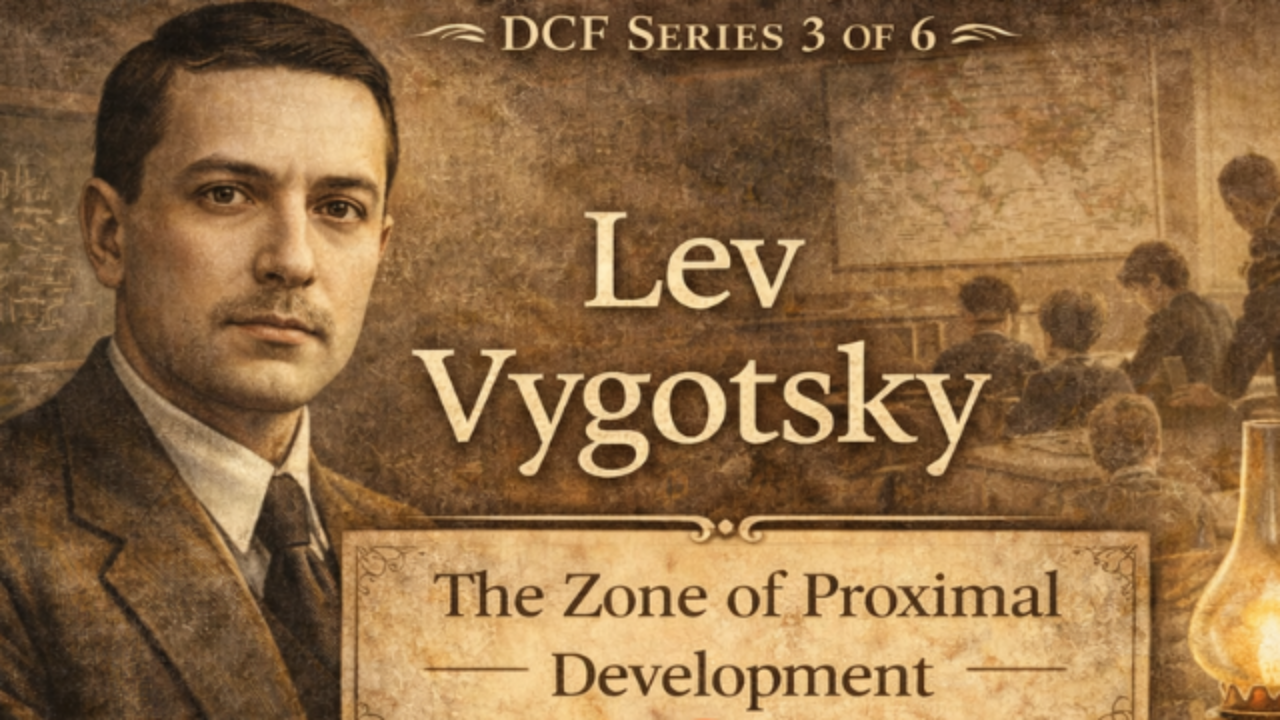
Lev Vygotsky
The Zone of Proximal Development as a Window into Nervous System Co-Regulation
|
|
Lev Vygotsky died of tuberculosis in 1934, at the age of thirty-seven. He had been actively publishing for less than a decade. In that compressed window he produced more than 180 works — many of them compiled posthumously from notes and never intended for the form in which we now read them. His work was suppressed by Stalinist authorities shortly after his death, and by the time translations began reaching Western researchers in the 1960s and 1970s, he had been dead for forty years.
What is less commonly known is that Vygotsky began not as a psychologist, but as a literary critic. His doctoral dissertation was an analysis of Shakespeare's Hamlet. That literary sensibility — an attentiveness to complexity, ambiguity, and the way meaning is constructed through relationship — never left his psychological writing, and is part of why his work remains so generative nearly a century later.
|
|
"Vygotsky understood, decades before the neuroscience existed to prove it, that learning is a relational process — that what we can become is shaped by who accompanies us."
|
|
The Zone of Proximal Development: A Definition
Vygotsky defined the Zone of Proximal Development (ZPD) as "the distance between the actual developmental level as determined by independent problem solving and the level of potential development as determined through problem solving under adult guidance or in collaboration with more capable peers" (Vygotsky, 1978, p. 86).
In simpler terms: the ZPD is the gap between what a learner can do alone and what becomes possible when they are supported by a more skilled or more experienced other. It is the relational space in which growth happens — not the place where the learner already is, and not the place so far beyond them that independent arrival is impossible, but the developmental frontier that becomes accessible in supported relationship.
|
What Neuroscience Adds: Co-Regulation and the Social Brain
The neuroscience of co-regulation begins with a deceptively simple observation: the human nervous system does not regulate itself in isolation (Porges, 2011). From the earliest moments of life, the regulatory state of the infant's nervous system is organized through proximity to, and attunement with, the caregiver's nervous system. This is not a feature of infancy that disappears in adulthood — it is a feature of human neurobiology that persists across the lifespan. Adults in states of stress, novelty, or challenge continue to regulate more effectively in the presence of attuned, regulated others (Coan et al., 2006).
What Vygotsky called the ZPD can be understood, through this neuroscientific lens, as the regulated relational space within which a learner's nervous system is sufficiently supported to engage with novelty, tolerate challenge, and integrate new understanding. Remove the regulated other, and the frontier contracts. The learner is left with only what they can manage alone.
|
|
"The ZPD is not merely a learning theory. It is a description of how the regulated nervous system of a more experienced other creates the neurobiological conditions for the learner's growth."
|
|
Peer Learning and the ZPD
A feature of Vygotsky's original formulation that is frequently underemphasized is his inclusion of "more capable peers" alongside adult guidance as sources of ZPD scaffolding. This points toward something that contemporary learning science confirms: peer learning, when well-structured, is among the most powerful drivers of professional development (Boud et al., 2001).
A group of experienced clinicians in a continuing education context represents an enormous pool of ZPDs, each of which can serve as scaffolding for the others. Training designs that build in structured peer consultation, small group discussion, and collaborative problem-solving are not supplementing the real learning that happens in didactic presentation. They are activating the relational scaffolding without which deep learning is neurobiologically improbable.
|
Clinical Supervision and Consultation as ZPD
Vygotsky's framework has particular relevance for clinical supervision — the sustained, relational, developmental relationship through which clinical competence is built over time. Supervision is, in Vygotskian terms, the prototypical ZPD: a more experienced other providing calibrated, responsive scaffolding within which the supervisee's clinical frontier expands.
The ZPD-informed consultant begins by creating conditions for the consultee to lead — to articulate the clinical problem in their own terms, to surface what they already know and where they feel uncertain. The consultant listens not only for content but for developmental information: Where is this clinician's actual frontier? The consultant's first job is not to answer. It is to locate the frontier. You cannot scaffold what you have not yet found.
|
Clinical Application: ZPD-Informed Training Design
|
Conduct brief pre-training needs assessment to identify participants' actual developmental frontiers, rather than assuming homogeneity.
|
|
Design small group work that pairs participants with different levels of experience, creating natural ZPD dynamics within the peer group.
|
|
Build in explicit scaffolding for skill practice — structured observation, guided reflection, graduated challenge — rather than expecting transfer from didactic content alone.
|
|
Calibrate challenge to the frontier: content too far below participants' competence creates boredom; content too far above creates overwhelm and shutdown.
|
|
Name the co-regulatory dimension of the training relationship explicitly — participants learn better when they understand that the trainer's regulated presence is itself a learning resource.
|
|
References
Boud, D., Cohen, R., & Sampson, J. (Eds.). (2001). Peer learning in higher education. Kogan Page.
Coan, J. A., Schaefer, H. S., & Davidson, R. J. (2006). Lending a hand. Psychological Science, 17(12), 1032–1039.
Cozolino, L. (2013). The social neuroscience of education. W. W. Norton.
Porges, S. W. (2011). The polyvagal theory. W. W. Norton.
Schore, A. N. (2012). The science of the art of psychotherapy. W. W. Norton.
Vygotsky, L. S. (1978). Mind in society. Harvard University Press.
Wood, D., Bruner, J. S., & Ross, G. (1976). The role of tutoring in problem solving. Journal of Child Psychology and Psychiatry, 17(2), 89–100.
|
|
Series Navigation
↠Post 2: John Dewey — Experience, Democracy, and the Regulated Learner
→ Post 4: Maria Montessori — Self-Directed Learning and Autonomic Safety
|
|
|
|
REWIRED360
Rewiring how therapists learn, lead & thrive.
|
© 2026 Kathy Couch, LCSW. All rights reserved.
|
|
|